
Budget meal plan: two weeks with shopping lists and prices
Two weeks of budget meals, with portions, macro estimates and printable checklists for one or two people. Week one retains the Lidl Italy catalogue snapshot from 13 September 2026: €64.95 at checkout for one person, including €41.83 of food consumed. Week two reuses supplies and needs €44.97 in new purchases in the worked example for 21 September: two verified Lidl offers plus historical prices for the other products, not a fully current quote.
The bill stays low because the meals rely on pulses, eggs, pasta and chicken breast. Fresh vegetables, such as courgettes and broccoli, are used almost entirely within the week, so fresh produce does not end up in the bin.
Cooking two portions at once also cuts your time at the stove in half for those dishes. If you happen to skip a meal or eat out, you can freeze the cooked portion. Alternatively, keep the raw ingredients in the freezer or cupboard for the following weeks. This cheap weekly meal plan handles unexpected changes without letting food go to waste.

How many calories and how much protein each day
The menu provides an average of 2,006 kcal and 133 g protein each day, alongside 252 g carbs and 52 g fat. As you can see in the table below, daily energy intake ranges from 1,900 to 2,109 kcal, while protein fluctuates between 118 and 150 g depending on the scheduled meals.
This variation across different days is completely normal. You do not need every single day to hit your targets to the exact gram. What matters is your overall average across the full week. If you want to explore the role of each nutrient in your diet, you can read more in our guide explaining what macros are.
If your personal energy target is higher or lower than this plan, you can adapt your portions easily. The most practical way to adjust your calorie intake without reducing your protein is to change the amounts of complex carbohydrates. You can simply increase or scale back the pasta, white rice, wholegrain bread and oats that you eat throughout the week.
| Day | kcal | Protein | Carbs | Fat | Food cost |
|---|---|---|---|---|---|
| Monday | 1,900 | 118 g | 279 g | 32 g | €4.74 |
| Tuesday | 1,987 | 124 g | 220 g | 67 g | €5.33 |
| Wednesday | 1,920 | 146 g | 255 g | 34 g | €6.93 |
| Thursday | 2,074 | 127 g | 266 g | 56 g | €5.86 |
| Friday | 2,109 | 121 g | 268 g | 60 g | €4.80 |
| Saturday | 2,077 | 150 g | 260 g | 50 g | €7.46 |
| Sunday | 1,978 | 142 g | 215 g | 64 g | €6.70 |
| Average | 2,006 | 133 g | 252 g | 52 g | €5.98 |
Values worked out from the grams of each portion with the per-100 g data of the GetYourMacros ingredient database. Cost of the food eaten at Lidl Italy shelf prices as of 13 September 2026.
Unused food keeps well: chicken breast and wholegrain bread go straight into the freezer, white rice and dried lentils remain in your cupboard, and frozen peas return to the freezer.
Fresh vegetables, including courgettes and broccoli, and fresh dairy are used almost entirely within the week, ensuring nothing spoils in your fridge drawer.
To avoid spending more than necessary, stick to the 26 products on the list. Preparing your shopping list in advance and avoiding items not on the list is the most effective way to protect your budget.
What it really costs: the food you eat versus the receipt
The food you eat over these seven days costs €41.83 (€5.98 a day), based on Lidl shelf prices in Italy on 13 September 2026. At the till, however, the receipt comes to €64.95 because you must buy whole retail packs.
The difference of €23.12 is not wasted money: it buys staples that stay in your cupboard, fridge or freezer for the following weeks. The largest individual items at the checkout are chicken breast (€8.29), extra virgin olive oil (€6.99), Greek yogurt 0% (€5.97), cottage cheese (€3.87) and turkey mince (€3.49).
You use fresh vegetables and dairy almost entirely within the seven days. Even so, you finish with 885 g of extra virgin olive oil, 750 g of white rice, 850 g of frozen peas, 900 g of potatoes and 360 g of dried lentils, plus 200 g of wholegrain bread and 300 g of chicken breast to freeze. The second checklist below calculates which supplies to reuse and which packs to buy, including cupboard staples. It does not automatically deduct fresh leftovers: check storage and use-by dates first.
To see which sources give you the best nutritional value for your money, read our detailed analysis of protein per euro.
Week-two calories and macros
| Day | kcal | Protein | Carbs | Fat |
|---|---|---|---|---|
| 8 · Monday | 1989 | 112 g | 305 g | 31 g |
| 9 · Tuesday | 2041 | 110 g | 265 g | 56 g |
| 10 · Wednesday | 2020 | 108 g | 280 g | 54 g |
| 11 · Thursday | 2145 | 123 g | 320 g | 40 g |
| 12 · Friday | 2028 | 136 g | 254 g | 50 g |
| 13 · Saturday | 2140 | 130 g | 289 g | 48 g |
| 14 · Sunday | 2041 | 121 g | 254 g | 59 g |
| Average | 2058 | 120 g | 281 g | 48 g |
Per-person estimates calculated from the listed quantities and the GetYourMacros ingredient catalogue retrieved on 20 September 2026. These are average calculations, not measurements of the cooked dish.
Quantities for preparing the meals
Open a dish to see the ingredients for one serving. Double them for two people; when also preparing the next day's lunch, cook two servings per person.
Weigh rice, pasta, oats and lentils dry; canned pulses and tuna are drained. Milk and oil are shown in ml, retaining the first week's calculation convention. Check usable weights, shells, peel and actual packs for eggs and fruit. Salt, pepper and optional spices are excluded.
Offers used and the other flyers checked
For the worked shopping example on 21 September 2026, two products in the second checklist use Lidl offers with no loyalty-card requirement. Carried stock retains its original cost; other products retain historical prices, as stated below each checklist.
- Fucino IGP carrots: 800 g for €1.19; 17–23 September 2026. Official flyer, page 4.
- Selenella potatoes: 1.5 kg for €2.29; 21–23 September 2026. Official flyer, page 53.
| Chain | Edition checked on 20 September 2026 | How to use it |
|---|---|---|
| Lidl | Italy: 17–23 September; preview for 24–30 September. | Dates can differ by product. The two offers above are included in the calculation; offers for 24–30 September are not. |
| Eurospin | National feed: 10–20 September; no newer grocery edition returned when checked. | These offers end before the example shopping date of 21 September and are not used in the totals. |
| Coop | Campania: 17–27 September, reference store in Naples, Via Camillo Porzio 102/103. | Local edition: check your store. Coop prices are not mixed into this example's Lidl total. |
| Conad | Superstore Campania, reference 006451: Campioni del Risparmio 9–20 September, Convenienza Più 16–22 September and Spunta 1 August–30 September. | Editions and conditions depend on the store. Do not extend a promotion beyond its printed dates. |
This check covers the editions available on the stated date, not the full assortment or prices at every Italian store. Replace expired prices before shopping, and check any Lidl Plus, app or loyalty-card conditions.
Cheap swaps that keep your macros in shape
Getting 25 g of protein costs between €0.33 for dried lentils and €1.60 for canned tuna in water, based on Lidl Italy prices on 13 September 2026.
In the table below, you can compare the cost per standard portion across common sources. You can swap ingredients to hit the same protein target, but you must keep an eye on total calories. Pulses cost less than meat, but they also add carbohydrates. Eggs (€0.83) add fat. Check the balance of your whole meal whenever you pick a cheaper alternative.
| Food | Protein per 100 g | kcal per 100 g | €/kg | € per 25 g of protein |
|---|---|---|---|---|
| Dried lentils | 24 g | 340 | 3.18 | €0.33 |
| Canned chickpeas (drained) | 7 g | 120 | 2.04 | €0.73 |
| Eggs | 12.5 g | 130 | 4.15 | €0.83 |
| Chicken breast | 23 g | 110 | 8.29 | €0.90 |
| Parmigiano Reggiano | 33 g | 392 | 12.45 | €0.94 |
| Canned cannellini beans (drained) | 7 g | 100 | 2.71 | €0.97 |
| Greek yogurt 0% | 10 g | 57 | 3.98 | €0.99 |
| Turkey mince | 19 g | 144 | 8.72 | €1.15 |
| Cottage cheese | 11 g | 98 | 6.45 | €1.47 |
| Canned tuna in water | 23 g | 100 | 14.68 | €1.60 |
Lidl Italy shelf prices as of 13 September 2026; nutrition per 100 g of product as sold (dried pulses weighed dry).
Swapping 25 g of protein from canned tuna in water for canned chickpeas costs €0.73 instead of €1.60, based on Lidl Italy shelf prices on 13 September 2026. You can do the same with turkey mince at €1.15 by switching to chicken breast at €0.90 or dried lentils at €0.33. For your snacks, picking Greek yogurt 0% at €0.99 instead of cottage cheese at €1.47 reduces your food spending without lowering your protein intake.
These swaps involve practical differences you need to consider. Pulses add carbohydrates to your plate and increase calories compared with a portion of lean meat. Varying your protein sources also helps you stick to your eating habits without getting tired of the same flavours. You can find more options in our guide to cheap protein sources.
How not to waste food and money during the week
The staples left after the first week only count as a saving if you do not throw them away. Before you head to the supermarket, check your kitchen cupboards and fridge against the 26 products on the shopping list to see what you already have in stock. It also pays to schedule your grocery shopping straight after a main meal. Walking through the supermarket aisles on a full stomach keeps you focused on what you need and prevents unplanned purchases.
Once you return home, manage your fresh food right away by separating items you will not cook over the coming days. The menu leaves 300 g of chicken breast and 200 g of wholegrain bread: portion and store these in the freezer straight away before they can spoil. Make sure you use delicate fresh vegetables such as courgettes and broccoli during the first days of the week, saving hardier ingredients like frozen peas for your later meals.
Another vital step is separating the till total from the true cost of each meal. Understanding how to approach eating healthy on a budget means looking at what you actually put on the plate, not at the till total.

Adapting the menu to your calories and your budget
The menu is built for one person, but you can adapt it if your targets or household differ. If you cook for several people, scale the main meal portions proportionally. Doing this also cuts down on leftover packets of dry staples like white rice or dried lentils. Remember that shelf prices vary by region and from week to week compared to what we found for healthy shopping at Lidl. If you eat pescatarian or vegetarian, you can swap chicken breast or turkey mince for eggs, canned beans, or lentils.
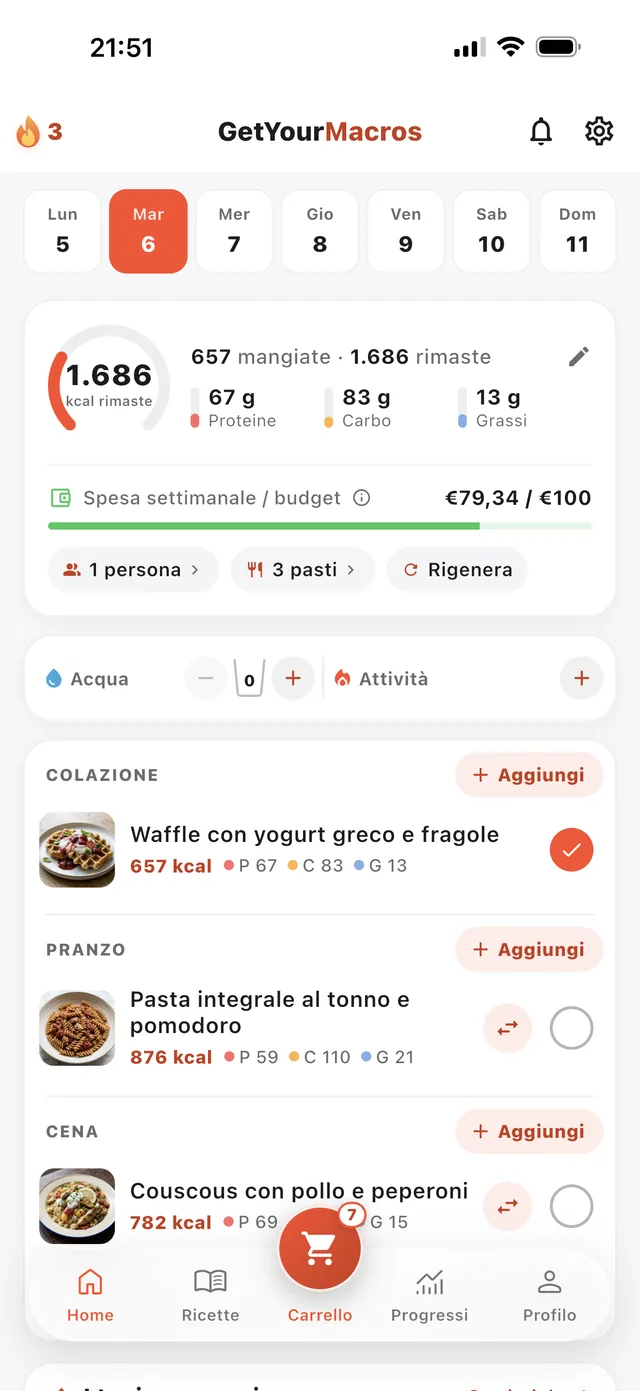
To manage these adjustments without manual maths, you can set up a personalised meal plan in GetYourMacros. The app builds your week from its recipe library around your calories, macros, diet (omnivore, pescatarian, vegetarian, vegan), allergens, ingredients to avoid, kitchen equipment, chosen supermarkets, weekly budget, and household size.
The app treats your weekly budget as a ceiling. If the plan goes over it, the app swaps the priciest dishes for cheaper ones; if the budget still cannot be met, the plan shows as over budget. In the cart, one tap adds the whole week's ingredients, with quantities of the same item added together and priced in whole packs for your chosen supermarkets.
How we worked out the menu, calories and prices
Week-one costs are based on Lidl Italy shelf prices in the GetYourMacros price catalogue as of 13 September 2026. For products on promotion, we used the regular full price rather than temporary discounts.
Calories and macronutrients are calculated from the portion sizes in each recipe, matched against the per-100 g values of the GetYourMacros ingredient database. The cost of food eaten counts only the grams you consume. The till total accounts for buying whole packs across the 26 products on the first shopping list. Week two uses a separate inventory for one or two people: it deducts only usable supplies, rounds new purchases to whole packs and retains the original cost of food already paid for. Two new Lidl prices are verified for 21 September; all other rows retain the stated historical catalogue prices.
Our calculation does not include salt, pepper, spices and herbs, but extra virgin olive oil is counted. Shelf prices vary by region and from week to week, although special offers can lower the bill. Figures are rounded to the nearest gram, calorie and cent.
Keep reading
To understand nutritional basics, read our guide on what macros are. If you want to compare nutrition costs, check our breakdown of protein per euro and the guide to cheap protein sources. You can find practical tips for discount stores in our guide to healthy shopping at Lidl. To manage your spending over the long term, you can read how to structure a budget diet.
Want the menu to become your groceries, split across your supermarkets? Discover the GetYourMacros smart shopping list.
Start for free
Get a weekly meal plan that respects your macros and your budget.