
Protein per euro: how many grams €1 actually buys
One euro spent on dried lentils buys 81 grams of protein. The same euro spent on bresaola buys 11. Same euro, same protein: your gut breaks both down into the same amino acids. We took the 444 foods that the GetYourMacros catalogue holds a Lidl or Eurospin shelf price for, crossed them with their nutrition data and ranked them by grams of protein for every euro. This page is what came out — including the awkward parts.
The ranking: the 20 foods with the most protein for €1
Regular shelf prices, no promotions, recorded at Lidl and Eurospin between July and September 2026; each food takes the lower of the two. The column that matters is g protein / €: how many grams you take home for one euro. The last column, kcal / 100 g protein, says how many calories you must eat to get 100 g of protein out of that food — and it is the column that dismantles half the ranking.
| Food | Protein / 100 g | €/kg | g protein / € | € / 100 g protein | kcal / 100 g protein | Chain |
|---|---|---|---|---|---|---|
| Dried soybeans | 36.5 | 3.98 | 92 | 1.09 | 1222 | Lidl |
| Chickpea flour | 21.5 | 2.58 | 83 | 1.20 | 1591 | Eurospin |
| Vital wheat gluten | 75 | 9.00 | 83 | 1.20 | 493 | Lidl |
| Dried split fava beans | 26.1 | 3.18 | 82 | 1.22 | 1307 | Eurospin |
| Dried lentils | 24 | 2.98 | 81 | 1.24 | 1417 | Eurospin |
| Dried cannellini beans | 23.4 | 2.98 | 79 | 1.27 | 1440 | Lidl |
| Dried red split lentils | 24.5 | 3.18 | 77 | 1.30 | 1312 | Eurospin |
| Black-eyed peas | 23.5 | 3.38 | 70 | 1.44 | 1430 | Eurospin |
| Soy flour | 37.9 | 5.78 | 66 | 1.53 | 1140 | Eurospin |
| Wheat bran | 15.3 | 2.38 | 64 | 1.56 | 1392 | Eurospin |
| Soy granules | 50 | 7.96 | 63 | 1.59 | 693 | Lidl |
| Textured soy chunks | 50 | 8.76 | 57 | 1.75 | 688 | Eurospin |
| Textured pea protein | 62.5 | 11.96 | 52 | 1.91 | 560 | Lidl |
| Lupin flour | 39 | 8.23 | 47 | 2.11 | 846 | Eurospin |
| Light quark | 12 | 2.78 | 43 | 2.32 | 546 | Eurospin |
| Soy protein powder | 85 | 19.98 | 43 | 2.35 | 435 | Lidl |
| Soy flakes | 40 | 9.96 | 40 | 2.49 | 1069 | Lidl |
| Pea protein powder | 80 | 19.98 | 40 | 2.50 | 475 | Lidl |
| Red lentil pasta | 25 | 6.36 | 39 | 2.54 | 1306 | Eurospin |
| Fresh sardines | 20.8 | 5.98 | 35 | 2.88 | 620 | Eurospin |
Source: GetYourMacros price catalogue, regular non-promotional shelf prices recorded at Lidl and Eurospin between 8 July and 10 September 2026. Filter: foods with at least 10 g of protein in 100 g and at least 25% of calories from protein (88 foods out of the 444 priced). Green marks entries below 800 kcal in every 100 g of protein.
The trap: flour beats everything, and flour is not a protein
Drop the protein-density filter and the ranking gets a new leader. Plain flour at €0.59/kg delivers 169 g of protein for one euro: nearly double the soybeans, more than fifteen times the bresaola. Nobody builds a high-protein diet on flour, and the reason sits entirely in the last column.
| Food | Protein / 100 g | €/kg | g protein / € | % kcal from protein | kcal / 100 g protein |
|---|---|---|---|---|---|
| Plain flour | 10 | 0.59 | 169 | 12% | 3410 |
| Wholemeal flour | 13 | 0.89 | 146 | 15% | 2608 |
| Durum wheat semolina | 12.2 | 0.89 | 137 | 14% | 2910 |
| Durum wheat pasta | 12 | 0.98 | 122 | 14% | 2958 |
| Breadcrumbs | 12 | 1.38 | 87 | 13% | 3000 |
| Rolled oats | 13 | 1.90 | 68 | 14% | 2885 |
| Chicken breast | 23 | 8.29 | 28 | 84% | 478 |
Same source and same period. Chicken breast is in the table as a benchmark.
To reach 100 g of protein from plain flour you have to eat a kilo of flour, and 3,410 kcal with it. From chicken breast, 435 g and 478 kcal do the job: seven times less. No calorie counter will get you to 200 g of protein inside 1,800 kcal on pasta, however cheap its protein looks by the gram. That is why a ranking by euro has to be read alongside the calories it drags along, and why a food is only a real protein source when protein makes up a large share of its calories. On a bulk, though, those extra calories become an advantage: our cheap bulking diet shows how.
The two columns that matter: g protein / € tells you what the protein costs, kcal / 100 g protein tells you how much room it takes up in your day. A good cheap protein sits high in the first and low in the second. Below 800 kcal in every 100 g of protein you will find 45 of our 88 foods.
The foods you actually buy, ranked by protein for €1
The overall ranking rewards dried pulses and textured soy. Real shopping baskets hold chicken, eggs, yogurt and tuna, and the practical question is how those stack up against each other. Here are fifteen everyday protein foods, same prices, same method.
| Food | Protein / 100 g | €/kg | g protein / € | € / 100 g protein | kcal / 100 g protein | Chain |
|---|---|---|---|---|---|---|
| Light quark | 12 | 2.78 | 43 | 2.32 | 546 | Eurospin |
| Fresh sardines | 20.8 | 5.98 | 35 | 2.88 | 620 | Eurospin |
| Eggs | 12.5 | 3.82 | 33 | 3.06 | 1040 | Eurospin |
| Whey protein powder | 80 | 25.98 | 31 | 3.25 | 475 | Lidl |
| Chicken breast | 23 | 8.29 | 28 | 3.60 | 478 | Lidl |
| Greek yogurt 0% | 10 | 3.78 | 26 | 3.78 | 570 | Eurospin |
| Chicken mince | 21 | 8.23 | 26 | 3.92 | 626 | Eurospin |
| Turkey breast | 24 | 9.48 | 25 | 3.95 | 458 | Eurospin |
| Boneless chicken thighs | 19 | 7.58 | 25 | 3.99 | 611 | Eurospin |
| Lean beef mince 5% | 20.5 | 10.48 | 20 | 5.11 | 620 | Eurospin |
| Skyr | 11 | 5.67 | 19 | 5.15 | 573 | Eurospin |
| Plain tofu | 12.5 | 6.76 | 18 | 5.41 | 960 | Eurospin |
| Salmon fillet | 20 | 11.56 | 17 | 5.78 | 925 | Lidl |
| Canned tuna in water | 23 | 14.04 | 16 | 6.10 | 435 | Eurospin |
| Bresaola | 32 | 29.90 | 11 | 9.34 | 469 | Eurospin |
Same source and same period. Regular non-promotional shelf prices, the lower of Lidl and Eurospin.
Three things stand out. Light quark is almost four times better value than bresaola and carries fewer calories by the gram of protein: it is the most underrated tub in the chiller. Whey powder, which almost everyone files under luxury, beats chicken breast — 31 g of protein for a euro against 28, at just 475 kcal in every 100 g of protein. And bresaola, the cured meat everyone associates with dieting, is the most expensive protein on the list: very lean, certainly, but you pay €9.34 for 100 g of protein against €1.24 from lentils.
Lidl or Eurospin? Far less than you think
Eighty-four protein foods are catalogued at both chains. Eurospin is cheaper on 62, Lidl on 4, and on 18 the price is identical. That looks like a rout, but the median gap is 6.1% and on 61 of the 84 the difference stays under 10% — less than the same product moves between one weekly flyer and the next. Only seven gaps are worth a detour.
| Food | Lidl €/kg | Eurospin €/kg | Gap | Cheaper at |
|---|---|---|---|---|
| Parmigiano Reggiano | 12.45 | 19.97 | 60% | Lidl |
| Prawns | 8.30 | 13.30 | 60% | Lidl |
| Salmon fillet | 11.56 | 17.96 | 55% | Lidl |
| Prosciutto crudo | 26.90 | 17.90 | 50% | Eurospin |
| Lean beef | 17.95 | 12.48 | 44% | Eurospin |
| Smoked salmon | 35.90 | 27.90 | 29% | Eurospin |
| Skyr | 7.25 | 5.67 | 28% | Eurospin |
The only 7 protein foods, out of the 84 stocked at both chains, with a gap of 20% or more. Same source and same period.
The conclusion is more useful than a league table of supermarkets: picking the food is worth eight times picking the shop. Moving from bresaola to lentils multiplies the protein your euro buys by seven; moving from Lidl to Eurospin shifts it by 6%. Splitting a shop across two chains is worth it for those seven products — which is exactly the calculation behind a shopping list split by supermarket.
What a week of protein costs
Take a realistic gym target: 140 g of protein a day, so 980 g a week. Here is what those 980 g cost depending on where you take them from. Protein foods only — sides, fruit, bread and dressings are a separate line.
Cost of the protein foods alone to reach 980 g of protein (140 g a day for 7 days), at September 2026 Lidl and Eurospin shelf prices.
Between the first basket and the last there is a factor of 3.5, for identical protein. The budget mix — 1 kg of lentils, 26 eggs, 1.3 kg of chicken breast and 2.4 kg of Greek yogurt — costs €28.89 a week, €4.13 a day, and brings roughly 1,190 kcal a day with it: plenty of room left for carbs, vegetables and fats inside a 2,000-2,400 kcal diet. The €74 basket holds exactly the same protein, and it is the one most people picture when they think of eating "on a diet".
It is also why a high-protein diet on €50 a week is not a stunt: protein, the line everyone assumes is the expensive one, takes €21 to €29 if you choose well, and leaves the rest of the budget to the rest of the plate.
Flyer offers are not always offers
The Lidl flyer running to 16 September 2026 carries 19 promotions on protein foods that the same store also sells off-promotion. We compared them by the kilo, Lidl against Lidl: 12 genuinely save money, 7 cost more than the non-promoted product. There is no accounting trick — the offer is nearly always on a smaller pack or a more processed variant, so the price by the kilo gets worse even as the ticket shows fewer euros.
| Promoted product | €/kg | Same food on the shelf | €/kg | Difference |
|---|---|---|---|---|
| Red-fruit porridge 56 g at €1.00 | 17.86 | Rolled oats 500 g at €0.95 | 1.90 | +840% |
| Brezel breadsticks 150 g at €1.99 | 13.27 | Breadsticks 250 g at €1.29 | 5.16 | +157% |
| Marinated salmon 250 g at €4.79 | 19.16 | Salmon fillets 250 g at €2.89 | 11.56 | +66% |
| Kefir stracchino 160 g at €1.50 | 9.38 | Stracchino 250 g at €1.69 | 6.76 | +39% |
| Smoked salmon 200 g at €3.99 | 19.95 | Smoked salmon 100 g at €3.59 | 35.90 | −44% |
| Almonds 200 g at €1.69 | 8.45 | Almonds 200 g at €2.69 | 13.45 | −37% |
| Brie 200 g at €1.50 | 7.50 | Brie 200 g at €1.99 | 9.95 | −25% |
Lidl flyer 10-16 September 2026, read by our automated importer and compared against Lidl shelf prices for the same food. The first four rows cost more by the kilo than the non-promoted product; the three highlighted rows are real offers.
The top four rows all tell the same story: a 56 g porridge sachet is still oats, but by the kilo it costs nine times the half-kilo bag; the salmon "on offer" is marinated in a small tray, and costs 66% more than the plain fillet on the same counter. The practical rule is banal and almost nobody applies it in the aisle: look only at the price by the kilo, never at the pack price and never at the percentage printed on the sign. The best offers of the week — smoked salmon at −44%, almonds at −37%, brie at −25% — are not the ones with the biggest sign.

How these numbers were worked out
It is worth saying where the data comes from, because that is the part no "cheap protein" listicle ever writes down.
The GetYourMacros catalogue holds 448 canonical ingredients with nutrition values by 100 g. 445 of them carry at least one price: 444 on the shelf at Lidl and 429 at Eurospin, plus a smaller number from Conad, Esselunga, Coop, Carrefour, MD and Penny that we left out here because the coverage is too thin to compare honestly. Prices come from three sources: manual in-store surveys, reports from app users who photograph the shelf tag (read by a recognition model), and the weekly flyers imported automatically. The recording window runs from 8 July to 10 September 2026.
For each food we took the lowest regular, non-promotional shelf price of the two chains, ignoring offers: an offer ends, and a ranking built on offers expires in a week. From there, three elementary sums: grams of protein for a euro are protein by 100 g × 10 ÷ price by kg; the cost of 100 g of protein is price by kg ÷ protein by 100 g; calories in 100 g of protein are kcal by 100 g ÷ protein by 100 g × 100. Nutrition values are those of the raw product, or as sold.
The limits, stated plainly: discounter prices vary by region and by store, a product can be out of stock, and dried pulses are weighed dry (100 g of dried lentils becomes roughly 250 g cooked, but the protein stays the same). We made no correction for protein quality: if the amino acid profile matters to you, pulses want pairing with grains, while eggs, dairy and meat are complete on their own. And we did not count cooking time, which for a dried pulse is a real cost even though it never shows up on the receipt.
Correction, 13 September 2026: in the first version the € / 100 g protein column showed values ten times too low (€0.36 instead of €3.60 for chicken breast). Every cell is now recalculated from the same row's €/kg and protein per 100 g; the g protein / € column, the calories and the weekly costs were already correct.
Finding these prices in every weekly shop
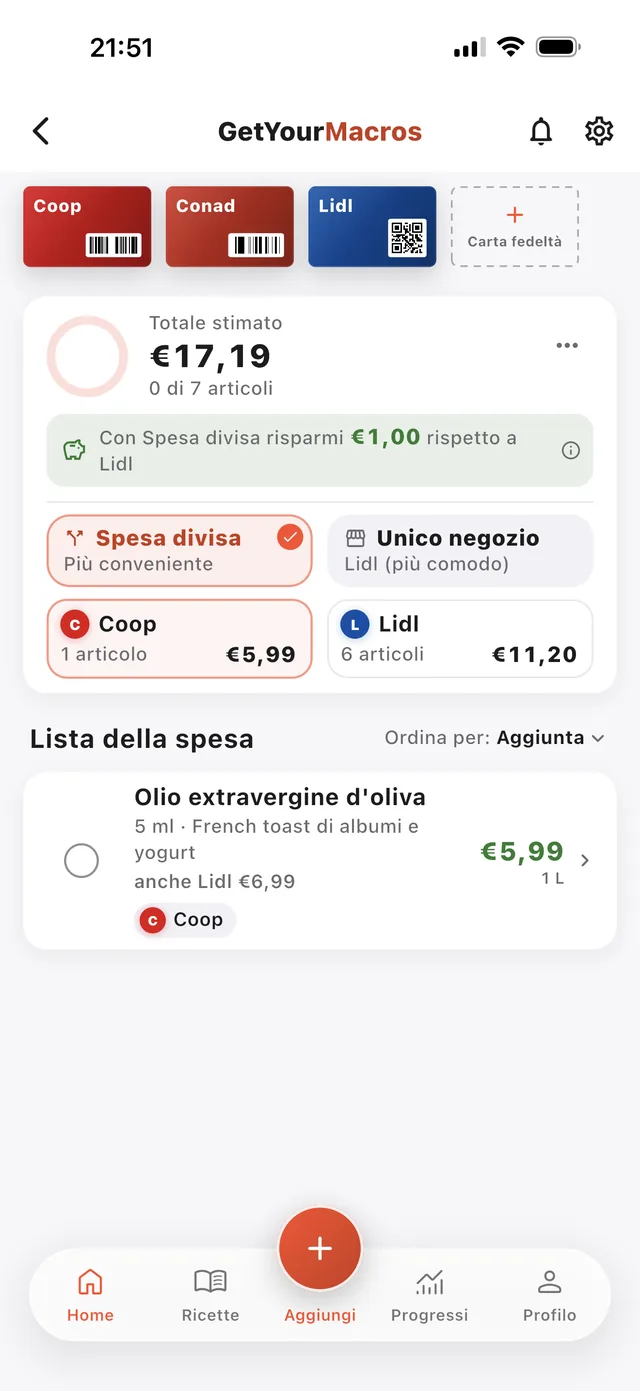
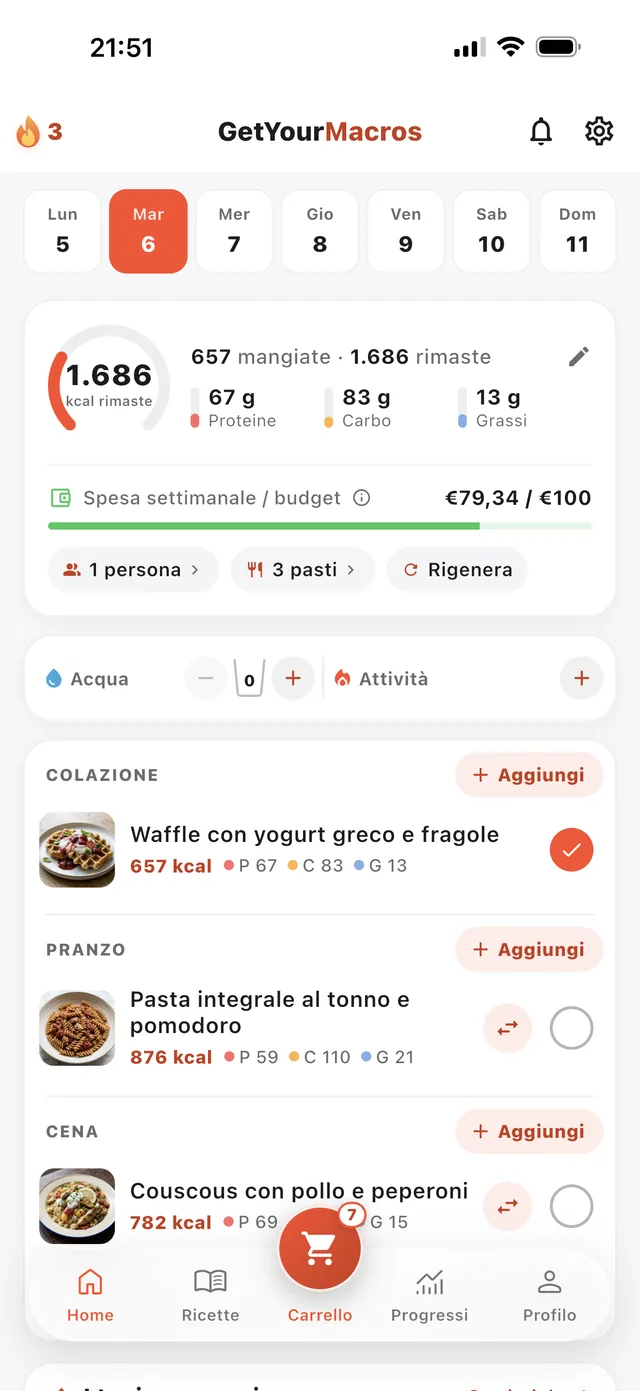
A ranking gets read once; prices change every week. GetYourMacros is the free iOS and Android app these numbers come from: it builds a weekly meal plan around your macros, turns it into a shopping list and splits that list across the supermarkets you choose, showing what you save against buying everything in one store. Prices are the ones reported by the community — scan a barcode or photograph the shelf tag — and products discounted in the flyers of the supported chains show up flagged in the cart with the date the offer ends. Where a price is missing, the app shows an estimate labelled as such.
Frequently asked questions
Which food gives the most protein per euro?
Across the 444 foods in our catalogue with a Lidl or Eurospin price, dried soybeans come first with 92 g of protein per euro (€3.98/kg). For something more everyday, dried lentils give 81 g per euro and light quark 43 g per euro. Among fresh animal proteins the winners are sardines at 35 g per euro, then eggs at 33 g.
How much does 100 g of protein cost?
Almost entirely down to the food you pick. At September 2026 prices, 100 g of protein costs €1.24 from dried lentils, €2.32 from light quark, €3.06 from eggs, €3.60 from chicken breast, €5.78 from salmon and €9.34 from bresaola. First to last is a factor of eight.
How much does a week of high-protein eating cost?
For 140 g of protein a day, or 980 g a week, the protein foods alone cost between €21 with a plant-based mix and €74 buying only lean cured meat and fish. A realistic mix of dried pulses, eggs, chicken and Greek yogurt costs €29 a week, about €4.13 a day.
Is Lidl or Eurospin cheaper for protein?
Across the 84 protein foods both chains stock, Eurospin is cheaper on 62 and Lidl on 4, but the median gap is 6%. Only 7 products differ by 20% or more: Parmigiano Reggiano, prawns and salmon are cheaper at Lidl, while prosciutto crudo, lean beef, smoked salmon and skyr are cheaper at Eurospin. Choosing the food matters far more than choosing the chain.
Is protein powder expensive?
No, it sits in the upper half of the ranking. Whey at €25.98/kg gives 31 g of protein per euro, slightly more than chicken breast at 28 g, and carries just 475 kcal for every 100 g of protein. Soy and pea protein powder at €19.98/kg reach 43 and 40 g per euro. The tub price is frightening, the price by the gram is not.
Keep reading
If you buy nearly everything in one chain, healthy shopping at Lidl lists product by product what to put in the basket with September prices. For the general thinking on low-cost protein, omnivore and plant-based, there is the guide to cheap protein sources. And to turn all of this into seven days of meals, see budget meal planning.
Want these prices already applied to your week? Discover the GetYourMacros budget diet.
Start for free
A weekly plan that respects your macros and your budget, with your supermarket's prices.