
Flexible dieting: how the 80/20 rule works (and what it costs)
Thirty grams of protein can cost €0.24 or €2.80, depending on the food you choose. They can bring along 141 calories or 888. Flexible dieting starts right here: numbers rule, forbidden food lists disappear. With the right data you can build your meals independently, matching your physical goals with your supermarket receipt.

What flexible dieting is (and what it isn't)
Flexible dieting, often called IIFYM (If It Fits Your Macros), is a method based on simple maths. You have a daily calorie ceiling and a precise target for the three macronutrients: protein, carbohydrates, and fats. There are no magic foods or forbidden items, just a daily budget to stick to based on your lifestyle and physical goals.
If you meet those four numbers at the end of the day, your body cares little about where they came from. Thirty grams of carbohydrates from a plate of rice or a chocolate bar are broken down into the same basic sugars. From a purely energetic standpoint, your metabolism makes no moral distinction between one food and another.
Be careful, though: flexible does not mean without rules. Your calorie budget and macronutrient targets represent a rigid constraint that requires precision and organisation. If you decide to spend your entire margin on a heavy meal, you will have to deal with the remaining numbers. True freedom of choice always relies on a solid structure.
This approach by no means implies living on pastries or fast food. The hidden constraint, which many unfortunately ignore, is that you still need to reach a daily quota of fibre and essential micronutrients. If you spend all your macros on highly processed foods, you will reach the evening hungry, tired, and lacking vitamins, making the journey impossible to sustain over time.
This is why flexibility is a means to live better, not an excuse to eat poorly. It allows you to fit in the snack you like without guilt, but it forces you to balance the overall budget. It is a puzzle where you choose the pieces. Finally, remember that in the case of eating disorders, medical conditions, or pregnancy, this method should never be started without professional support.
True freedom of choice relies on a solid structure: the calorie budget is a rigid constraint that requires organisation.

The 80/20 rule, explained with numbers
The theory suggests getting 80% of your calories from unprocessed foods and leaving the remaining 20% for whatever you prefer. Let us translate this into real numbers to understand what it means in practice.
Take a daily requirement of 2,200 kcal. Twenty per cent equals 440 calories. This is your daily discretionary allowance, the leeway that makes the diet sustainable in the long run without driving you mad.
With 440 calories, you can comfortably include an ice cream, a couple of slices of bread with jam, or a savoury snack. You will not compromise your results, provided the remaining 1,760 calories are covered by nutritious, fibre-rich sources.
What happens if you start loosening the reins and the 20% becomes 40% of your total calories? The numbers stop adding up. By replacing too many whole foods with sweets or snacks, your fibre intake plummets. The immediate result is that satiety decreases, hunger skyrockets, and sticking to the plan becomes an ordeal.
Another common mistake in this management involves drinks like beer or wine. Many people simply do not count them at all, believing liquids are irrelevant. In reality, a couple of glasses can easily erode your entire 20% budget without giving you any sense of satiety, completely throwing off your daily calculations.
Remember, however, that this margin is a maximum ceiling, not a mandatory target. If one day you are full and prefer to use those calories for a larger portion of chicken or potatoes, you can certainly do so. Flexibility is meant to give you breathing room, not force you to squeeze in a daily cheat.

How to calculate your macros
A common way to calculate your macros begins by setting protein between 1.6 and 2.2 g per kg of bodyweight. After that, set your fat between 0.8 and 1 g per kg. Finally, cover the remaining calories with carbohydrates, knowing that protein and carbs provide 4 kcal per gram, while fat provides 9.
If you want to see detailed numerical examples, read the practical explanations in our guide on what macros are. You can also examine two complete profiles worked out with the app's formulas on the flexible dieting page, which help you compare your daily targets.
The real test: 30 g of protein, 18 foods, from €0.24 to €2.80
Flexible dieting claims that any food can fit into your macros. But at what price, both in euros and calories? We compared 18 foods to find out what 30 grams of protein really costs. Durum wheat pasta is the absolute cheapest source: 30 g of protein cost just €0.24. The problem is that to get them you have to eat 250 g of pasta, taking in a massive 888 kcal. A disaster for your daily budget.
| Food | Grams | Cost | kcal | €/kg |
|---|---|---|---|---|
| Pasta | 250 | €0.24 | 888 | 0.98 |
| Red split lentils | 122 | €0.39 | 394 | 3.18 |
| Rolled oats | 231 | €0.44 | 865 | 1.90 |
| Low-fat quark | 250 | €0.69 | 164 | 2.78 |
| Peanut butter | 107 | €0.76 | 643 | 7.11 |
| White rice | 429 | €0.77 | 1521 | 1.79 |
| Eggs | 240 | €0.92 | 312 | 3.82 |
| White bread | 375 | €0.93 | 973 | 2.48 |
| Whey protein powder | 38 | €0.97 | 142 | 25.98 |
| Chicken breast | 130 | €1.08 | 143 | 8.29 |
| Parmesan | 91 | €1.13 | 356 | 12.45 |
| Greek yogurt 0% | 300 | €1.13 | 171 | 3.78 |
| Mozzarella | 167 | €1.19 | 422 | 7.12 |
| Tofu | 375 | €1.21 | 285 | 3.23 |
| Lean beef mince (5% fat) | 146 | €1.53 | 186 | 10.48 |
| Salmon fillet | 150 | €1.73 | 278 | 11.56 |
| Canned tuna in water | 130 | €1.83 | 130 | 14.04 |
| Bresaola | 94 | €2.80 | 141 | 29.90 |
Source: GetYourMacros price catalogue, regular non-promotional shelf prices recorded at Lidl and Eurospin in September 2026. Grams are of the raw product or as sold, and the calories are the ones those grams bring with them. Highlighted: the best trade-off between the two columns.

Often the lowest price on the receipt translates to a very high cost in terms of energy. Take white rice: to reach the protein quota you spend only €0.77, but you have to ingest a whopping 1,521 kcal. If you compare it with tuna in brine, the difference is stark. The fish costs you €1.83, but provides the same protein with only 130 kcal.
At the opposite end is bresaola. It gives you 30 g of protein for only 141 kcal, but it sets you back a hefty €2.80. It is excellent caloric efficiency, paid for dearly on the receipt.
The true champions of balance are found in the middle. Low-fat quark offers 30 g of protein for €0.69 and 164 kcal. Whey protein powder costs €0.97 and brings only 142 kcal. They are even cheaper than chicken breast, which requires €1.08 for 143 kcal.
The choice depends on the phase you are in. If you are cutting, your calorie budget is tight. You need to invest a few extra euros in lean sources. If you are bulking, calories are abundant. You can save money by using more caloric plant-based sources to reach your 30 g of protein without emptying your wallet.
Often the lowest price on the receipt translates to a very high cost in terms of energy.
Flexible does not mean expensive
One of the main advantages of this approach is that it allows you to shop according to your budget. A rigid meal plan forces you to buy salmon or bresaola even when they cost too much. Flexibility gives you back control over your finances, without making you feel guilty if you decide to cut costs to save money.
With flexible dieting, if salmon fillet (€1.73 for 30 g of protein) is out of budget, you can easily swap it. You can opt for tofu at €1.21 or fall back on eggs at €0.92. Your macros do not change, your receipt does.
You can decide to invest your euros where it really matters. Instead of paying €1.83 for tuna in brine for the same protein quota, you have very valid alternatives. You can use 5% lean minced beef at €1.53 or fat-free Greek yoghurt at €1.13.
Let us look at another concrete swap taken from our table. If you are tired of chicken breast at €1.08, you can get 30 g of protein with low-fat quark at €0.69. Even split red lentils, at just €0.39, are perfect for cutting costs without sacrificing nutrients.
There is, however, an honest limit to this reasoning that you must remember. Prices change by region and by week based on supermarket offers. Furthermore, dietary variety matters much more than a single economic swap. Alternating sources is essential to ensure you do not miss out on anything.
Following this path for free means using data to your advantage. You do not need a nutritionist to force expensive foods on you. You just need to know the impact of each food on your calories and your wallet to create a truly sustainable plan.
The mistakes that make it fail
The first classic mistake is immediately eating your 20% quota of treats. Always start the day with protein sources and vegetables. Otherwise, you will reach the evening with no macros available to fill you up. Build your main meals before adding snacks, or hunger will take over.
Ignoring fibre is an equally damaging misstep. Many focus solely on the main macronutrients while neglecting the rest. Without adequate fibre intake, digestion worsens and hunger pangs increase dramatically. This makes it almost impossible to maintain a calorie deficit over time.
Weighing cooked food using raw nutritional values messes up your whole day's maths. Pasta more than doubles its weight when cooked, while meat loses water and shrinks. Always weigh everything raw before you start cooking to avoid incorrect calculations.
Treating the daily target like an exam to pass generates completely unnecessary anxiety. If one day you go over by 200 kcal due to something unexpected, do not panic. Simply cut them gradually over the next two days. The weekly average is what counts, not the perfection of a single day.
Forgetting oil and various dressings is the fastest way to wipe out an entire calorie deficit. A single untracked tablespoon of olive oil adds about 90 calories to your plate in a second. Use a dispenser to dress your food; never pour oil straight from the bottle.
The final mistake is relying on the app's database values without checking the label of the product you actually have at home. Food companies often change recipes. Read the packaging to log the real data. Ultimately, keep the right perspective in mind: these are accounting errors, not failures of willpower.

Putting it into practice with an app
Doing this on paper works, but daily tracking takes time and method. Recalculating grams and calories every time you cook soon becomes demanding. In the GetYourMacros app, calorie targets come from Mifflin–St Jeor, with fat at 25% of calories and carbs taking the rest. Every value remains fully editable by hand.
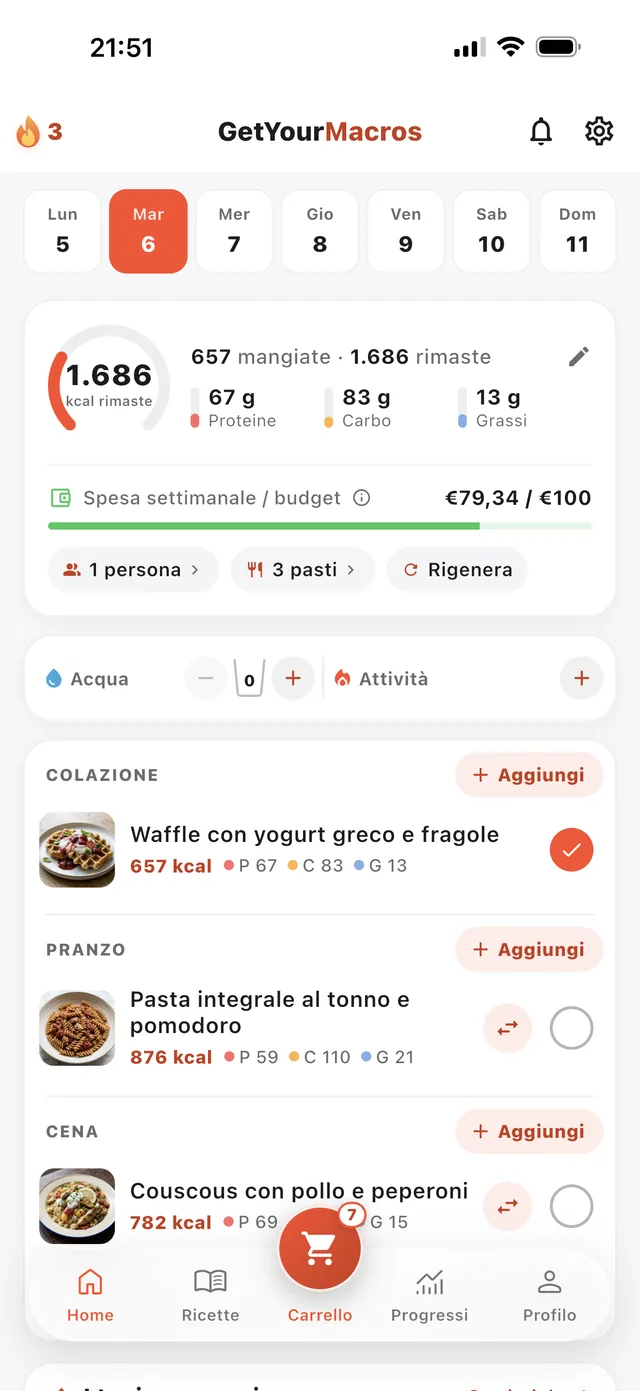
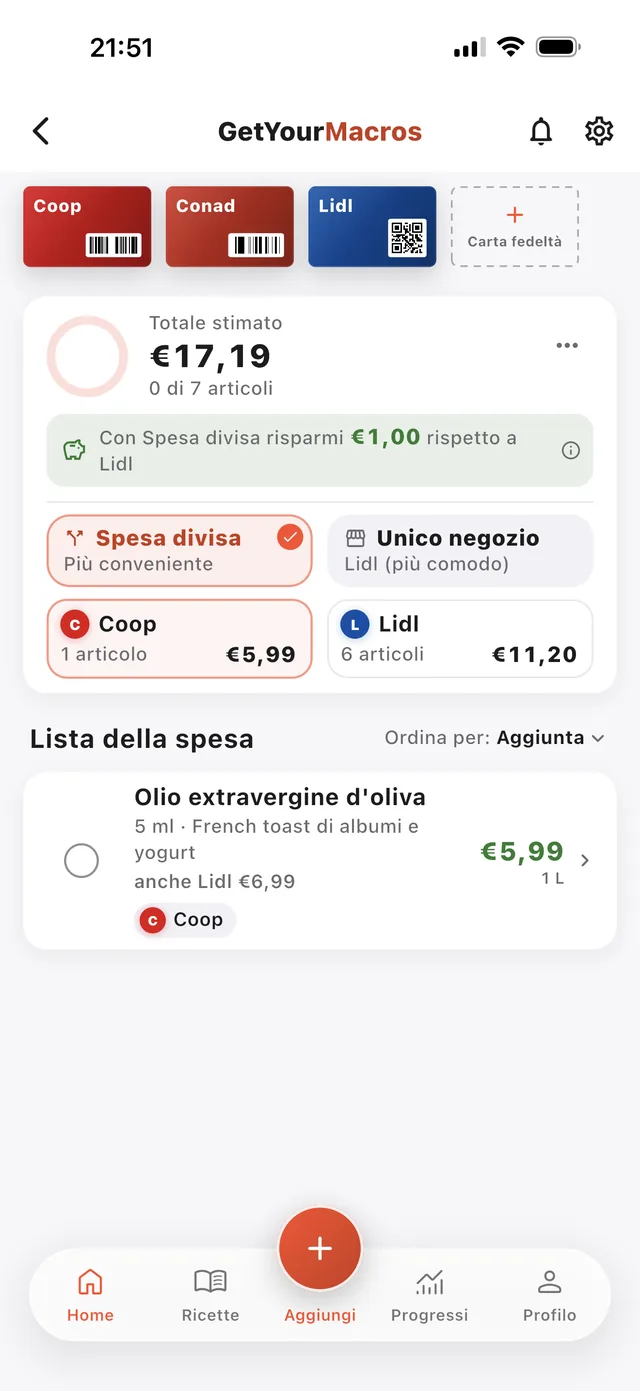
From your targets, the app builds a weekly meal plan of balanced recipes. One tap replaces any dish with another rescaled to the same calories. Once you settle on your menu, you add the whole week's ingredients to the shopping list in one tap. This removes the manual maths, showing you what to buy to reach your targets.
Frequently asked questions
Does flexible dieting work for weight loss?
Yes, if you are in a calorie deficit. Weight loss depends on your total energy balance, not on eliminating specific foods. By tracking macros, you ensure you eat fewer calories than you burn, while maintaining muscle mass.
What is the difference between flexible dieting and IIFYM?
There is no difference between them: flexible dieting and IIFYM refer to the exact same approach. IIFYM stands for "If It Fits Your Macros". Both focus on tracking your calories and daily macronutrients rather than banning specific foods. You can eat what you prefer, as long as it fits your daily targets.
How much does it cost to eat counting macros?
It depends on your choices. You can spend very little using eggs (€0.92 for 30 g of protein) or low-fat quark (€0.69). The cost rises if you choose salmon (€1.73) or bresaola (€2.80).
Can you really eat anything?
Yes, no food is forbidden, but you must meet your daily targets. If you eat highly caloric and unfilling foods, you will exhaust your macros quickly and go hungry for the rest of the day.
How do you calculate macros to start?
Set protein between 1.6 and 2.2 g per kilogram of weight. Fix fats between 0.8 and 1 g per kilogram. Fill the remaining calories with carbohydrates. A free app can do this calculation automatically.
Keep reading
For the full numbers behind the table above, the guide to protein per euro ranks 88 protein foods by grams of protein for one euro. For the groundwork there is what are macros, and to turn all of it into seven days of meals, budget meal planning.
To go from the principles to your first steps in the app, follow the practical guide to your first free meal plan: setup, meal swaps, shopping and diary checks with screenshots.
Want the app to work out calories and macros for you? See flexible dieting with GetYourMacros.
Start for free
Set your macros, track your meals and bring the shopping inside the budget.