
Flexible dieting: build your plan around calories and macros
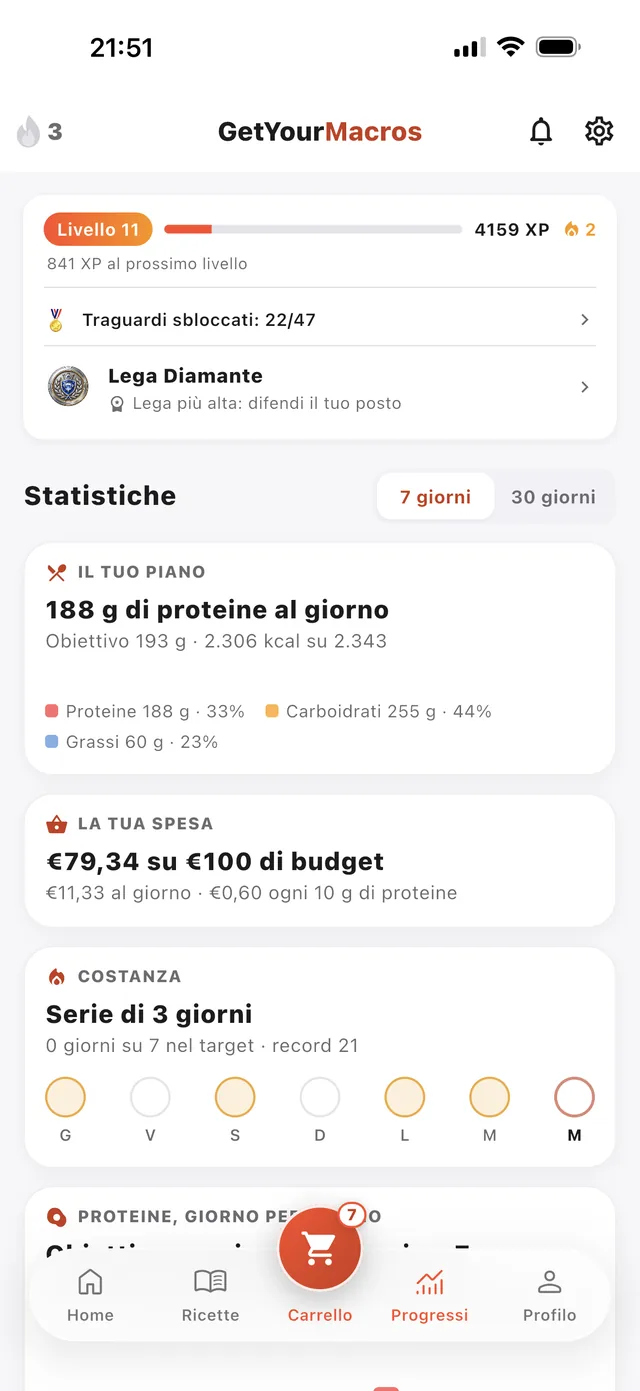
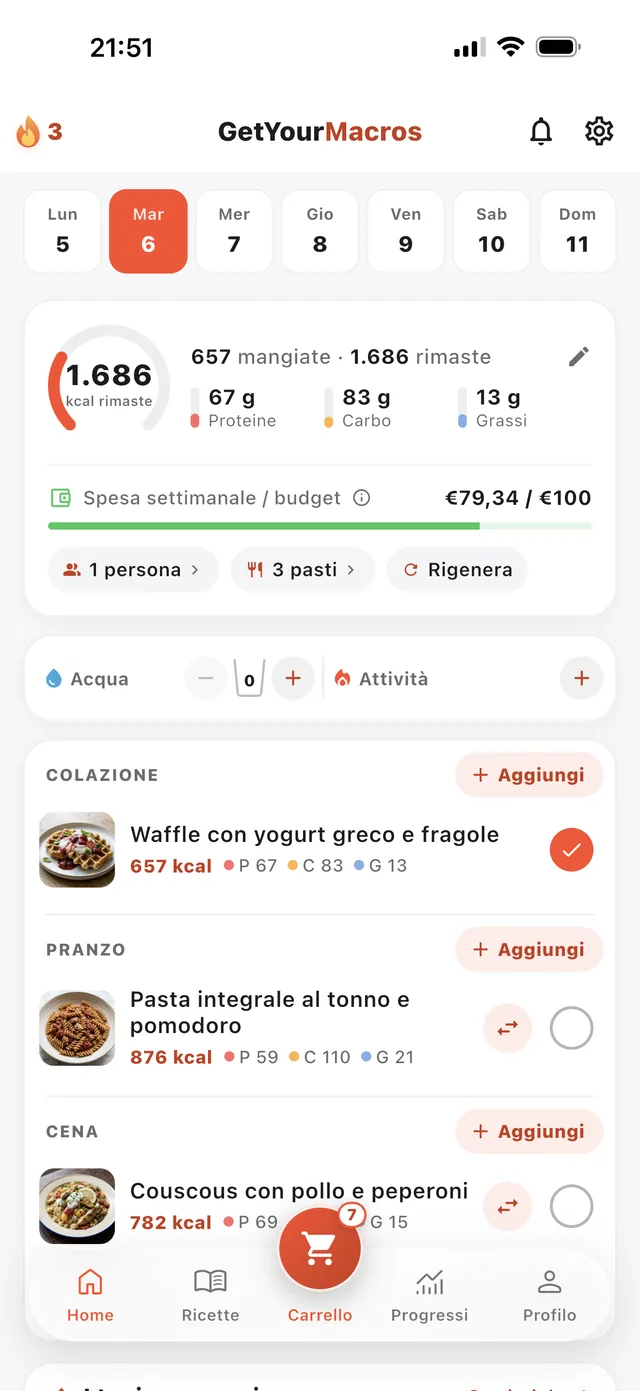
Flexible dieting is an approach built on daily calorie and macronutrient targets rather than lists of forbidden foods, and you can follow it for free with GetYourMacros: the free version gives you your first weekly plan, then 1 plan a month and 3 swaps a week. Available on iOS and Android, the app lets you start immediately without creating an account. It calculates your energy needs and builds a weekly plan from its recipe library. One tap swaps a dish for another of the same course, rescaled to the same calories with macros recalculated.

What flexible dieting is, in short
Flexible dieting, often known as IIFYM (If It Fits Your Macros), sets calories and macros and leaves the choice of foods to you. Instead of following rigid lists of forbidden foods, you only track your total daily energy and your three macronutrients: protein, carbohydrates, and fat. No food is banned in absolute terms. If a slice of pizza or a dessert fits within your daily targets, you can include it in your plan.
Flexibility does not mean eating junk food at every meal or abandoning all structure. Many people add the 80/20 guideline: roughly 80% of calories from minimally processed foods and 20% free. It protects nutritional quality: the majority of your food delivers micronutrients and satiety, whilst the free allowance helps you stay consistent over time.
To see how to manage your weekly grocery budget alongside the cost of protein, read our complete guide to flexible dieting.
How the app works out calories and macros
The app sets a daily calorie floor of 1,200 kcal for women and 1,500 kcal for men to protect your baseline intake. Your energy targets start with an estimate of your basal metabolic rate using the Mifflin–St Jeor formula. This number is multiplied by your activity level, then adjusted according to your personal goal.
Once the app determines your daily calories, it splits your nutrients according to practical guidelines:
- Protein: between 1.8 and 2.2 g per kg of body weight, with a guaranteed minimum of 70 g.
- Fat: fixed at 25% of total daily calories.
- Carbohydrates: make up the rest of the calories to reach your set target.
If you want to explore the role of each nutrient in your nutrition, take a look at our guide on what macros are. While these formulas provide a clear starting framework, the application gives you complete flexibility. You can edit your calorie target and your macro numbers by hand at any time, tailoring the plan directly to your daily habits.
A worked example
Your daily target is 1,765 kcal if you are a 62 kg woman (30 years old, 165 cm, moderately active) aiming to lose weight at a normal pace. Starting from a BMR of 1,340 kcal, the app applies an activity factor of 1.55 to calculate maintenance at 2,077 kcal. Subtracting a 15% deficit (312 kcal) gives 1,765 kcal a day: 136 g of protein (2.2 g per kg), 49 g of fat (25% of calories), and 195 g of carbs.
For an 80 kg man (35 years old, 180 cm, lightly active) looking to maintain weight, maintenance and daily target are 2,413 kcal a day. This sets 144 g of protein (1.8 g per kg), 67 g of fat, and 309 g of carbs.
| Example A | Example B | |
|---|---|---|
| Profile | woman, 30, 165 cm, 62 kg | man, 35, 180 cm, 80 kg |
| Activity | moderate (× 1.55) | light (× 1.375) |
| Goal | lose weight, normal pace | maintain weight |
| BMR | 1,340 kcal | 1,755 kcal |
| Maintenance | 2,077 kcal | 2,413 kcal |
| Adjustment | −312 kcal | 0 kcal |
| Calories a day | 1,765 kcal | 2,413 kcal |
| Protein | 136 g | 144 g |
| Fat | 49 g | 67 g |
| Carbs | 195 g | 309 g |
Worked out with the app's own formulas: Mifflin–St Jeor, activity factor and goal adjustment; protein per kg of bodyweight, fat at 25% of calories, carbs the rest. In the app the values can be edited by hand.
Truly flexible: dishes, meal style and diets
You get 3 swaps a week on the free version of the app to change any dish in one tap. When you choose to modify a meal, the app replaces it with another dish of the same course, rescaled to the same calories. Macros are recalculated and are not guaranteed to be identical, but your total daily calorie intake stays unchanged.
You can also choose a meal style to match your routine: one-dish meals, an Italian two-course structure (primo and secondo), or a mixed format with two courses at the weekend. The plan supports omnivore, pescatarian, vegetarian, and vegan diets. In your preferences, you can set both your allergens and specific ingredients to avoid, ensuring suggested recipes leave them out.
This gives you a meal plan tailored to your kitchen. You do not have to follow rigid food rules or spend time recalculating portions by hand when you want to eat something different.
From diet to groceries, inside your budget
The app treats your weekly budget as a ceiling. If your plan goes over it, the app swaps the priciest dishes for cheaper alternatives; if the budget still cannot be met, the plan shows as over budget.
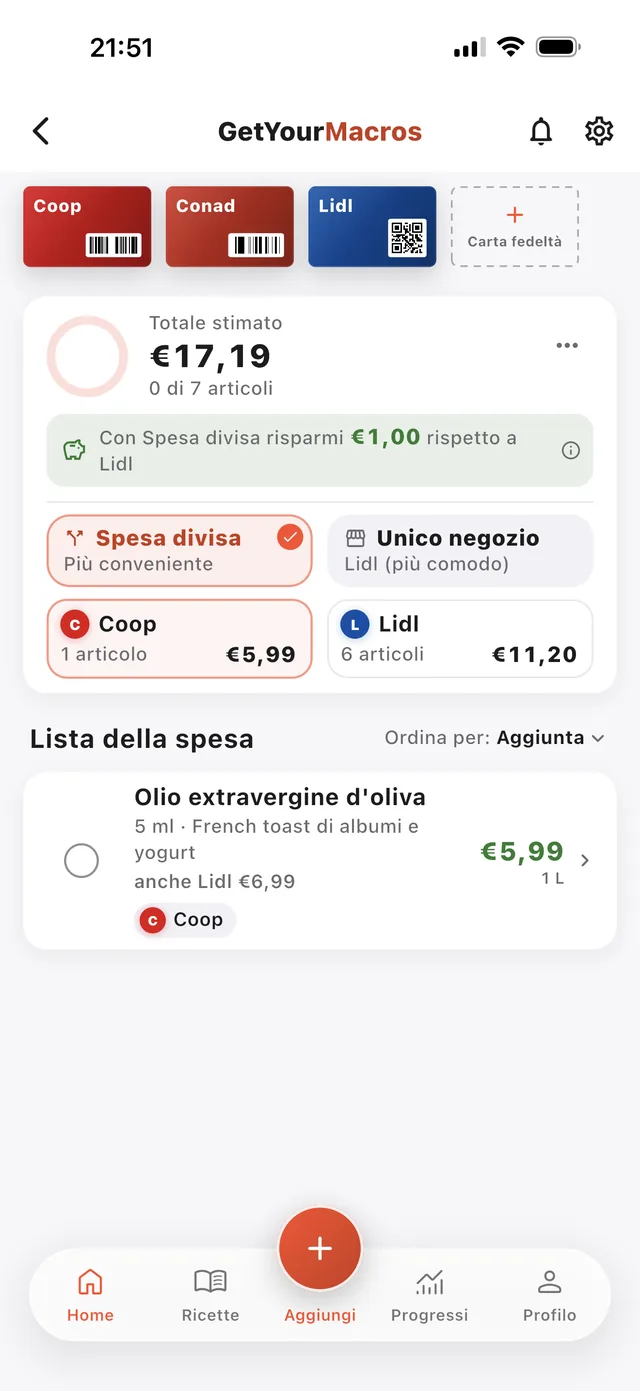
In one tap, you add all the week's ingredients to your shopping list, with quantities of the same item added together. Each product is assigned to your chosen supermarkets, priced in whole packs, and marked with an "On offer" badge if it appears in flyers from Lidl, Eurospin, or Conad. The app also compares splitting your shopping across stores against buying everything in a single shop.
This helps because the same macros can come with very different price tags on a flexible diet. To find the most economical sources, check the guide on protein per euro.
Pros and limits
The advantages
- No forbidden foods: no food or food group is banned. Every dish fits into your plan as long as it matches your daily calorie and macro targets.
- Social sustainability: you can handle dinners out or social lunches with friends without feeling excluded, simply by adjusting your portion sizes across other meals that day.
- Flexible shopping: you can adapt your grocery purchases to your weekly budget and local supermarket offers, varying your ingredient sources based on shelf prices.